Sex, Drugs and Subway on Sukhumvit Road

KC: Thanks to the journalistic bravery of the Bangkok Post, we finally have a substantive piece written about the sleaze circus that is lower Sukhumvit which is something less than an expose and more of a belated realisation that things are actually happening on the streets. I was inspired to include this article due to my own New Year’s Eve shenanigans during which a somnolent stroll around Nana seemed like an appropriate course of action post-club. The area is certainly one of the most depraved in the modern world, it has a McDonalds and a Subway, both opening around the clock to serve up their speedy treats to the knackered. I used Subway as a safety bunker after being marauded by two seemingly vicious Ladyboys after my wallet, only to find its garish space more threatening than the estrogen-pumped scallies hunting the pavements.I suspect the article offers little surprises to those that have traversed this major thoroughfare in the small hours, but it is an insight into the levels of vice occurring and the ever-present hand of corruption perpetuating the carnage.

Bangkok Post

http://www.bangkokpost.com/news/investigation/30100/bangkok-sleazy-street-of-shame

It’s been described by both Thais and foreigners as shameful, a disgrace and embarrassing. And those are the words we can print. One of the most popular areas in Bangkok, the lower end of Sukhumvit Road undergoes a rapid transformation late every night when most of the bars and clubs are closing.

MOBILE: In Soi 7, drinkers gather around a van-cum-bar,

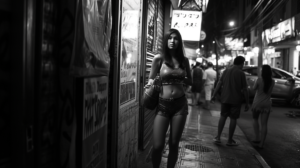
It changes from being a popular shopping and entertainment area into one of the world’s biggest open air flesh markets, where everything from girls to booze and illegal drugs are openly sold until the wee hours.

“You must come to see the place, especially after 2am when it degenerates into a total mess. Please go there and write what you have seen,” one disgusted Thai who owns a shop in the area told Spectrum.

Our investigation, which included interviews, pictures and videos, some taken with concealed cameras, revealed some very disturbing facts and some blatant violations of the law. This disregard for the law is happening in this area night after night, and no one appears to be making a serious effort to stop it.

Sukhumvit Road would surely hold the world record for the most illegal bars in one place. For about 500 metres on the popular road - from Soi 2 to Soi 15 - Spectrum counted 37 mobile bars, more than 204 tables and 1,180 chairs last Friday at 3am.

SETTING UP: Sukhumvit Road just after 1am. The crowds arrive after 2am,

The second dubious world record could be for the largest number of ladyboys gathered in one place, with some serving drinks at the mobile bars, some just walking around alone, and others in groups on the footpath, shouting at passing foreigners: “I want to go with you.”

Another fact that has surprised many visitors to the area is the large number of foreign prostitutes there searching for customers, as well as the local variety. The ever increasing number of foreign prostitutes do a brisk business in the nearby discotheques and coffee shops as well as on the street.

They come from about 16 countries - Africa, Asia, the Middle East or the former states of the Soviet Union - and have been joined recently by transvestites from other parts of Asia and the Middle East. This may not be a world record, but it is a first for this country.

There are also hundreds of African men in the area late at night, and they gather in many places along the lower end of Sukhumvit Road, with some offering illegal drugs to foreigners, mainly in sois 3 and 13. This type of open drug dealing on the street is unprecedented in Thailand. Many of these African men are also involved in other illegal scams, especially ones relating to the US dollar. They also fight each other regularly on the streets, usually over business conflicts or over women.

Most foreigners holidaying in Thailand with their families only see the temples, enjoy the country’s natural beauty and its beaches and are in bed by midnight. But if they ventured out onto the lower end of Sukhumvit Road late at night, they would get a very different, and negative, impression of the country.

LIGHTS OUT: Nana Plaza in Soi 4 goes dark at 1am, but the action continues until 2am,

Many of the foreign men who frequent this area late at night come from countries in the Middle East, where most of what is available on the streets of Bangkok is banned, illegal, or both.

Most are on holidays and don’t have to wake up for work early in the morning, so they stay up all night looking for entertainment.

And when most of the mainstream entertainment venues close at 2am, they move to the many small mobile bars that spring up after hours on Sukhumvit Road. The late night mobile bars started appearing on Sukhumvit Road after a change in the closing hours laws several years ago.

The changes, some of which involved earlier closing hours, cut the income of a lot of entertainment venues in the area.

One foreigner who has owned bars in Soi Cowboy for many years told Spectrum. “When that guy in the government [former Interior Minister Purachai Piumsombun] changed the closing hours back in 2001, making us close earlier, we really suffered, and so did our staff,” he said.

“When the bars had to shut earlier, we lost that important last busy hour of trading, and our profits went down. The customers headed off looking for some illegal place to drink after hours where there were girls available, and they soon found it on the footpath on Sukhumvit Road. The girls who worked in bars like mine no longer had the late night venues like the Thermae to go to in the hope of finding a customer after work.

DIRTY: Bars set up among the night’s rubbish on the lower end of Sukhumvit Road.

“After they closed the bars early, the girls just took to the streets. At least when they work in bars like mine, there are some controls and regulations, like regular health checks.

“What really annoyed me and most of the other bar owners was that we had to stop selling alcohol, while the other unlicensed places that sprung up on the streets can stay open all night.

“These days it seems more relaxed and the closing time has slipped back to 2am. People used to fly from Singapore to Bangkok for the nightlife, but now it’s the opposite way around. Singapore now has bars that open until the early hours.

“All the early closing and social order campaign did was to turn the lower end of Sukhumvit Road into a slum. That’s what it is. Now we still have to close at a certain time, we still have to have licences and face regular checks by the police, but there’s no checks or anything on these mobile bars. They wheel them out and put on the footpath on Sukhumvit late at night every night.”

His comments were echoed by Thai bar and pub owners who operate businesses along the lower end of Sukhumvit Road. One man who runs a well-known night spot that has been open for 40 years near Soi 15 said: “Before, I was able sell drinks until 6am. Everyone was inside, drinking and happy. Then in 2001 the government started to impose regulations and orders. For a short time we had to close at midnight, and this made things even worse because after midnight everyone moved to the street. The problems began and continues to now, as you can see.

“We are licenced to sell alcohol, we pay taxes to the state, we don’t allow under-age people to enter, we close according to the law, but we are losing money and going out of business because the mafia can sell all night on the street and undercut our prices. Their only overheads are the corruption money they pay someone. I know who it is, but won’t tell you for your own good.

“If Purachai could inspect Sukhumvit at night now - something he used to enjoy - he would most probably commit suicide. It is hard to imagine that this has been going on for years without anyone in the government making some serious efforts to stop it as laws and regulations are openly violated. What is happening on the street is a real shame for this country. Someone should take some drastic action.”

Pornchai, who has worked as a waiter at this well established bar, added: “I have been working here for 36 years, but now is the worst time ever. The mobile bars, all illegal, are taking our business by selling all night and cutting our prices. They can sell drinks cheaper because they only spend money on bribes to some officials. Their expenses are therefore much less than ours.”

He told Spectrum about one mobile bar frequented by Africans in Soi 13 where he said drugs are sold openly and where there are fights between the African dealers almost every night. About 20 Africans, some well dressed, were drinking there at 11pm when Spectrum visited. When one photo was taken, two Thai men immediately appeared and threatened the photographer, ordering him to leave, despite his valid argument that the footpath and road are public property where anyone can take a photo.

The same problem arose when taking pictures of the mobile bars. One bar owner who was selling alcohol on the footpath opposite Nana Post Office near Soi 4 appeared extremely irritated and shouted: “I control the footpath here. I own it. Get out!”

Later that night when Spectrum went back to the bar on Soi 13, about 80 Africans were drinking there, one group of them standing on the corner, attempting to chat with passing foreigners. Several foreigners told us the Africans were offering some shady business propositions and also drugs.

”They asked me how much money I have and how much I could invest with them,” said a man from Switzerland who did not want to be identified. Other Europeans said they were approached the same way.

One Thai vendor selling clothes near Soi 7 said: ”I have been selling here for almost 20 years but have never seen such corruption and disregard for the law as it is now. These mobile bars started to pop up a few years ago and now there are almost 40. Each pays someone 2,000 baht per day to stay open. I pay someone else only 1,000 baht for my space.

”Many Thai and foreign prostitutes frequent the area late at night, the Africans fight each other every night, especially in Soi 13. They sell marijuana, ice and cocaine. Many have no visas. They have a boss who is very powerful and controls many illegal activities, including the drug business. He knows some high-ranking Thai officials and is also well connected to his embassy.

SECOND SHIFT: Regular street vendors pack their belongings as the bars move in late on Sukhumvit Road.

”Not many policemen are seen here, except when the Africans fight, and then they will come. You will never see a high ranking policeman or other officials coming for an inspection. I suspect they don’t know what is going on here. In the past, police would arrest prostitutes who were looking for customers on the footpath, but not any more. That’s why there are so many now.

”We can’t blame only foreigners for these vices, but our people who allow it as well. The press doesn’t publish much about this problem. Our culture and dignity are destroyed here in front of us,” he said.

Another vendor selling hats in the next stall added: ”All the Thai people here don’t like it, but what can we do? How will this place look in the next five years? Are we going to become an African country? What are they coming here for? How can they stay here for a long time?”

This last question was partially answered by two Africans who approached the Spectrum team outside one mobile bar in Soi 3. One, who spoke perfect English, claimed to be a former pirate from Somalia who made a lot of money and came here to start a business. The other said he came from Sudan. He claimed to have been associated with terrorists in Sudan and said he had to leave.

”We do everything, except drugs,” the Somali said, with his Sudanese friend agreeing at the start of our 10-minute conversation. However, at the end of our chat, and after all their business propositions were rejected, they claimed to know someone who sells drugs, for either personal use or wholesale.

The Somali said they had to be careful after the police arrested several Africans at a small lane called ”Double White Hourse” off Soi 3 on Dec 12. He was referring to a raid made by the Narcotic Suppression Bureau and other agencies.

A visit to the lane, which is usually crowded with Africans after 10pm, found it almost deserted.

Several high-ranking officials from various embassies who live near the soi told Spectrum that while walking in the area at night they had been approached by African men who, after a short conversation, offered them drugs. This approach shocked many of the long-term embassy staff, as this had never happened in the past.

Back on Sukhumvit, the many foreign prostitutes, mainly from the former Soviet Union, were doing a brisk business, with dozens parading in provocative clothing from about 11.30pm on outside the coffee shop of a big hotel on Soi 3, which is their starting point before they move on to discos and other late night entertainment venues.

Several taxis were parked outside this hotel and often after the driver received a phone call, he would enter the coffee shop and get one or two of the foreign working girls and drive them to customers who stay in some of the big hotels in the district.

One taxi driver said the foreign girls charge 2,000-3,000 baht for a short time and 5,000-10,000 baht for an all night session. The taxi driver said he had an agreement with the staff of several big hotels, who call him when a guest wants ”company”. He and the hotel staff receive 500 baht each in commission.

During a conversation with several foreign working girls at the coffee shop, they revealed how they can stay in Thailand for many months, some even years.

They pay 5,000 baht each to a nearby travel agency which organises visa runs to Vientiane in Laos. One woman who had just returned from such a trip said the agency provided four vans which carried about 40 women. ”They collected our passports after arriving in Vientiane, where we spent one night in a cheap hotel, and returned them the next day with a Thai tourist visa. We can’t get these visas in Penang [Malaysia] or in Phnom Penh [Cambodia],” she said.

A ladyboy who was serving drinks at a mobile bar near Soi 11 said she and some of the other girls did not get paid to work at the bar, but used it to find customers to sleep with. However, several local prostitutes claimed that most of the ladyboys only pick up customers to steal their money.

The mobile bar business is well organised. The bars, chairs and tables are stored in many places along Sukhumvit Road during the day. The owners decorate the bars with colourful lights and have speakers blaring music. Bottles of alcohol are openly displayed. It takes only a few minutes to set one up.

However, some bars deliberately switch off the lights over the tables where their customers are drinking. Most of these bars move into their places after the street vendors leave about midnight. They become the second shift on the street.

As for hygiene, there is none. There are no public toilets in the area. Some customers relieve themselves where ever possible, making the whole area dirty and smelly. One enterprising local businessman in Soi 13 uses a pick-up truck with a mobile toilet on the back and charges five baht per person.

One friendly policeman from the local station who has been working in the area for many years was reluctant to say anything at first, but later opened up: ”Ten years ago it was very hard to open a bar, but now they are everywhere, not only the mobile ones.” He admitted that they are all illegal, but said his job was only to look after the traffic.

The policeman also mentioned that the punishment for selling liquor without a licence _ exactly what these mobile bars do every night _ is only a small fine not exceeding 500 baht for those selling local brews and not more than 2,000 baht for those selling imported brands.

”In case the bar gets raided again, the penalty would be same. Maybe if the punishment was higher, the bars might disappear. In a paradox, the ones who do possess a liquor licence and sell alcohol after midnight, when arrested, could face up to two years in jail or a fine not exceeding 4,000 baht or both, and their liquor licence could be suspended,” the policeman said.

”Considering the workload that the police have every night with more serious crimes, there’s really no time to tackle this type of offence,” he said.

After paying a fine, the bar can reopen, and if they are arrested again, even on same night, the penalty is the same.

”Maybe if the punishment was harsher, the bars might disappear,” he said.

Suvarnabhumi Airport’s Scammers


Bangkok Post

Taxi cheats, fake tour guides targeted.

Unregistered tour guides and taxis are facing fines of 2,000 baht and/or a year in jail as part of Suvarnabhumi airport’s new get tough policy.

The taxi cheats and illegal tour guides followed when Bangkok International Airport moved from Don Mueang to Suvarnabhumi three years ago.

There have been attempts to flush them out but they just keep coming back.

Airports of Thailand Plc chairman Piyaphan Champasut said yesterday a subcommittee on transport control at the airport had been set up in May to enforce suppression measures on illegal tour guides and taxis.

The subcommittee is chaired by Land Transport Department director-general Chairat Sanugansue.

A special operation unit will work on the ground to ensure the crackdown is effective.

It will also enforce measures such as zoning and parking time limits. Mr Piyaphan yesterday met the Tourist Police Bureau and the Department of Land Transport to discuss the problems at the airport.

The airport was declared a controlled area for tour guides and taxis in 2006.

Mr Piyaphan said scores of illegal tour guides and taxi drivers were arrested and fined, but they simply came back.

The airport will now strengthen the measures.

Unregistered tour guides and taxis could be fined 2,000 baht and face up to a year in prison.

The punishment would be heavier if they adopt an aggressive sales pitch or engage in physical abuse, and if they operate at night. They can be jailed for up to five years and fined up to 10,000 baht.

Mr Piyaphan was confident the stricter measures would start to show results in the next two months. Assessments would be made every 15 days to see if they were working.

KC: Can’t see this having any long term benefit. The measures may initially prove effective, but also open up new potential for corruption with the ’special operation unit’ being the target of scammers’ bribes. Suvarnabhumi, an airport plagued with controversy since its inception, has been a veritable breeding ground for scams and extortion both within and outside its walls. Its nature as the main gateway to Thailand makes it particularly important to Thailand’s image as a tourist destination, first impressions last after all. The airport often fails miserably in this role, especially with a vast number of taxi drivers and ‘tour operators’ desperate to milk tourists for every satang, ensuring they eventually arrive at their destination feeling cheated. I sincerely hope this new initiative is successful, although one remains sceptical that the scammers will will simply disappear. Please feel free to share any tales of Suwarnabhumi woe, or indeed positive experiences, in the comments section below.

The Nation’s Babes


KC: The increasingly vile, sychophantic and pointless Nation newspaper has this piece as a ‘MUST READ’ online today:

The Nation

Babes in the Hood

Few surprises but lots of curves as men’s magazine FHM awards ‘Sexiest’ ladies

FHM - short for For Him Magazine - celebrated its sixth anniversary and the announcements of the “FHM 100 Sexiest Women in the World” in style, throwing a party at the Centara Grand Hotel’s Bangkok Convention Centre with beautiful babes sashaying along the red carpet and lively sets by Girl Next Door & Playboy, Thaitanium and Girly Berry.

The magazine’s readers will already know that actress Megan Fox of “Transformers” fame has been named Sexiest Woman in the World 2009.

Here, Yardtip Ratchpal is the Sexiest Woman in Thailand while Patcharapa Chaichua was awarded the Sexiest Forever prize. The Sexiest Actress award went to soap star “Chompoo” Araya A Hargate while Morakot “Amy” Kittisara walked off with the beauty pageant title and Marisa Anita was named Sexiest Model.

Pitchanart Sakakorn won the Oriental Look award. She thanked everyone profusely and got all the guys’ hopes up when she said she’d be single from now on.

Sexiest Rookie Ausanee Wattana promised to wear a yellow bikini and teeth braces.

Soap star May Feung-arom again took the villainess title .

Other winners were singer Pakaramai “Tong” Potranan, Girly Berry for girl group and movie star Supaksorn “Kratae” Chaimongkol.

KC: This ‘report’ is described as an ‘Editor’s Pick’ and lists some frankly bizarre categorizations of sexy women: ‘Sexiest Forever’ and ‘Oriental Look’ for example. ‘Sexiest Rookie’ went to ‘newcomer’ Ausanee Wattana, obviously a new addition to celebrity culture and the hungry pages of For Him Magazine. There was even a ‘Sexiest Villainess’ category. I’m still searching for ‘Sexiest Khaw Man Gai Vendor’, ‘Sexiest MRT Official’ and ‘Sexiest Express Boat Attendent’. FHM seems to have missed those out this year. One fails to see why this is a ‘must read’, or even an ‘editor’s pick’, perhaps the report brightened up Thanong’s Khantong’s dreary wednesday morning. Whatever inspired Thanong to pick it, the reporter to report it and the Nation to print it, is key to the now irreversible destruction of this newspaper, which has become a moribund vessel of obsequious journalism and pointless, purile flotsam that stupifies even the most inquiring of minds.

War Weapons Seized


Bangkok Post

Police are checking the backgrounds of six drug suspects after they were allegedly found carrying war weapons and illicit drugs near the home of Interior Minister Chavarat Charnvirakul.

Metropolitan Police chief Worapong Chiewpreecha yesterday said the investigation would focus on finding the source of the weapons and checking the records of the suspects to see if they have been involved in any serious crimes.

Police believe the six might be members of a criminal network headed by alleged Klong Toey drug kingpin Sayam Sapworasit, alias Suparp Sidaeng. [Also known as 'Phap 70 Rai']

The six were arrested after the car they were travelling in was stopped at a police checkpoint on Narathiwat Ratchanakharin Road in Yannawa district shortly after midnight yesterday.

The suspects are Sasithorn Prommanee, 28; Khwan Thavornchan, 23; Uthen Saptrakul, 25; Chanont Rungroj, 20; Paweera Patchanee, 25, and Sommart Yudee.

Bang Pong Pang police conducting a body search of the driver of the white Honda Jazz, Mr Sommart, alias Moo Klong Toey, allegedly found two grammes of crystal methamphetamine, or “ice”.

The vehicle is owned by Ms Sasithorn.

Police say a search of the car boot turned up a large box containing two Uzi automatic weapons, two MT rifles, an AK-47 rifle, and 64 rounds of AK-47 ammunition. The weapons were loaded.

Also seized was 44,719 baht in cash, four to five baht in gold ornaments, seven mobile phones and a computer notebook.

Police later searched Ms Sasithorn’s apartment on Sukhumvit Soi 50 in Klong Toey district, and allegedly found two kilogrammes of “ice” with a street value of about 6 million baht.

Police said a 9mm automatic pistol, some bullets and seven bank account books were also found in her room. They say Ms Sasithorn told them she had been hired by a man to deliver the drugs to a customer in Klong Toey.

She also allegedly said she had made three deliveries and was paid 40,000 to 50,000 baht a time.

Police said Ms Sasithorn, when questioned about the weapons, claimed she had been hired by a man to pick up a box in Klong Toey on Monday, and was told someone would contact her.

They said she denied knowing the names of the people who hired her.

Pol Col Jiraphat Phumjit, deputy chief of the Metropolitan Police Division 5, said he believed the suspects were members of a drug ring allegedly run by Mr Sayam.

KC: Some additional info on drug kingpin Phap 70 Rai: He was arrested for drug trafficking in 2003 during Thaksin’s ‘War on Drugs’ and in 2004 Phap was sentenced to life in prison. He was also given twenty years for money laundering. His assets were seized by the Anti-Money Laundering Office (AMLO) and auctioned for twenty million baht. However, in 2005 Phap 70 Rai was acquitted of drugs chages in the Appeals Court. He continues to weild enormous social, economic and political influence in Khlong Toey.

Additional info from 2003:

“Supap Seedaeng, aka Sayam Sapworasit, nickname “Pap 70 rai”. Age: 35. From: Klong Toei.

Occupation: Car financing, drivers’ licence renewals and car insurance sales. He is suspected of using his legitimate businesses to launder money.

Arrested: March 26 this year at his Klong Toei home. He was allegedly implicated in a scam involving two other people who were arrested in 1998. Many of his assets were seized. A month after his arrest, his wife was also detained and another Bt100 million worth of assets were seized.

Assets impounded: Personal properties and those owned by Supap’s syndicate now under government control are estimated to be worth more than Bt230 million, but a portion of his worth is believed to have been absorbed into the syndicate’s assets. The Bt230million seizure is thought to represent about half of his actual worth.

Profile: Allegedly involved in drug running since 1994. Police believe such was the depth of his involvement, the syndicate was formed nine years ago specifically to manage illicit income.

Syndicate: Authorities seized assets listed as belonging to Supap and the syndicate, whose major players were thought to be active in Klong Toei slum’s major drug running clique”

Bangkok Airport Scam

BBC

Jonathan Head has this story:

Bangkok’s showcase new international airport is no stranger to controversy.

Built between 2002 and 2006, under the governments of then-Prime Minister Thaksin Shinawatra, the opening date was repeatedly delayed.

It has been dogged by allegations of corruption, as well as criticism of the design and poor quality of construction.

Then, at the end of last year, the airport was shut down for a week after being occupied by anti-government protesters.

Now new allegations have been made that a number of passengers are being detained every month in the duty free area on suspicion of shoplifting, and then held by the police until they pay large sums of money to buy their freedom.

That is what happened to Stephen Ingram and Xi Lin, two IT experts from Cambridge, as they were about to board their flight to London on the night of 25 April this year.

They had been browsing in the duty free shop at the airport, and were later approached by security guards, who twice asked to search their bags.

They were told a wallet had gone missing, and that Ms Lin had been seen on a security camera taking it out of the shop.

The company that owns the duty free shop, King Power, has since put the CCTV video on its website, which does appear to show her putting something in her bag. However the security guards found no wallet on either of them.

Despite that, they were both taken from the departure gate, back through immigration, and held in an airport police office. That is when their ordeal started to become frightening.

Interpreter

“We were questioned in separate rooms,” Mr Ingram said. “We felt really intimidated. They went through our bags and demanded that we tell them where the wallet was.”

The two were then put in what Mr Ingram describes as a “hot, humid, smelly cell with graffiti and blood on the walls”.

Mr Ingram managed to phone a Foreign Office helpline he found in a travel guide, and was told someone in the Bangkok embassy would try to help them.

The next morning the two were given an interpreter, a Sri Lankan national called Tony, who works part-time for the police.

They were taken by Tony to meet the local police commander - but, says Mr Ingram, for three hours all they discussed was how much money they would have to pay to get out.

They were told the charge was very serious. If they did not pay, they would be transferred to the infamous Bangkok Hilton prison, and would have to wait two months for their case to be processed.

Mr Ingram says they wanted £7,500 ($12,250) - for that the police would try to get him back to the UK in time for his mother’s funeral on 28 April.

But he could not arrange to get that much money transferred in time.

‘Zig-zag’ scheme

Tony then took them to an ATM machine at the police station, and told Ms Lin to withdraw as much as she could from her own account - £600 - and Mr Ingram then withdrew the equivalent of £3,400 from his account.

This was apparently handed over to the police as “bail”, and they were both made to sign a number of papers.

Later they were allowed to move to a squalid hotel within the airport perimeter, but their passports were held and they were warned not to leave or try to contact a lawyer or their embassy.

“I will be watching you,” Tony told them, adding that they would have to stay there until the £7,500 was transferred into Tony’s account.

On the Monday they managed to sneak out and get a taxi to Bangkok, and met an official at the British Embassy.

She gave the name of a Thai lawyer, and, says Mr Ingram, told them they were being subjected to a classic Thai scam called the “zig-zag”.

Their lawyer urged them to expose Tony - but also warned them that if they fought the case it could take months, and they risked a long prison sentence.

After five days the money was transferred to Tony’s account, and they were allowed to leave.

Mr Ingram had missed his mother’s funeral, but at least they were given a court document stating that there was insufficient evidence against them [what about the CCTV footage?], and no charge.

“It was a harrowing, stressful experience,” he said.

The couple say they now want to take legal action to recover their money.

‘Typical’ scam

The BBC has spoken to Tony and the regional police commander, Colonel Teeradej Phanuphan.

They both say Tony was merely helping the couple with translation, and raising bail to keep them out of prison.

Tony says about half the £7,500 was for bail, while the rest were “fees” for the bail, for his work, and for a lawyer he says he consulted on their behalf.

In theory, he says, they could try to get the bail portion refunded.

Colonel Teeradej says he will investigate any possible irregularities in their treatment. But he said any arrangement between the couple and Tony was a private affair, which did not involve the police.

Letters of complaint to the papers here in Thailand make it clear that passengers are regularly detained at the airport for alleged shoplifting, and then made to pay middlemen to win their freedom.

The Danish Embassy says one of its nationals was recently subjected to a very similar scam, and earlier this month an Irish scientist managed to flee Thailand with her husband and one year-old son after being arrested at the airport and accused of stealing an eyeliner worth around £17.

Tony told the BBC that so far this year he has “helped” about 150 foreigners in trouble with the police. He says sometimes he does it for no charge.

The British Embassy has also warned passengers at Bangkok Airport to take care not to move items around in the duty free shopping area before paying for them, as this could result in arrest and imprisonment.

KC: Unsure why Jonathan Head failed to ask Xi Lin if she stole the item when the video evidence seems to suggest she did put something in her bag. If she did, their argument is certainly weakened, but the situation was clearly exploited by the police and the sinister ‘interpreter’ Tony, who clearly profits from these scams, which appear to be on the increase and subject their victims to immense stress and financial problems. As one reader rightly stated the authorities are “using the excuse of a petty theft to kidnap and demand ransom.” Western media is giving a lot of print space to this story which can only serve to tarnish Thailand’s bruised image as a holiday destination even further.

See my earlier post on scams and comments for some additional context to this story.

Bombs Hit Hotels in Jakarta

The Guardian

At least six dead as bombs hit hotels in Jakarta

Bombs have exploded at the Ritz-Carlton and Marriott hotels in the Indonesian capital killing at least four foreigners

At least six people have been killed and 36 injured in two separate explosions at western-owned hotels in the Indonesian capital, Jakarta.

The blasts, which appeared co-ordinated, occuring nearly simultaneously, happened at the JW Marriott and the Ritz-Carlton hotels in central Jakarta.

South Jakarta Police Chief Firman Santyabudi confirmed the explosions had occured at both the luxury hotels in the upmarket neighbourhood.

“There were explosions heard from two separate places, one the JW Marriott, the other in the Ritz Carlton. We are still trying to check because right now we are still helping the victims,” he said.

A hospital official says 36 wounded in the blasts, including 11 foreigners, one who has been confirmed as being a New Zealander. One hospital emergency room said it was already treating 15 people.

The blasts blew out windows and scattered debris and glass across the street, after ripping the facade off the Ritz Hotel.

Witnesses at the scene told local television that the injured, including Indonesians and foreigners, were seen being taken away in ambulances.

“Some windows of the Ritz-Carlton building have been shattered, mostly on the lower section. I’m looking at it from my office,” Myra Junor, who works at a nearby building told Reuters.

A man jogging by the hotels said he first heard a loud explosion at the Marriott. Five minutes later, a bomb followed at the Ritz.

A Ritz Carlton employee said the Manchester United soccer team had been due to stay at the hotel ahead of an exhibition game in Indonesia early next week.

There have not been any major bomb blasts in Indonesia for several years, and this month the country’s presidential election passed off peacefully.

The Marriott hotel was attacked in 2003, when a car bomb killed 12 people. Southeast Asian terror network Jemaah Islamiyah was blamed in that blast.

That coincided with a period when Islamists militants carried out numerous attacks, including bombings in Bali in 2002 which killed 202 people.

KC: AFP now reporting there have been seven deaths. The fact that these attacks were coordinated suggests that they were orchestrated by a highly organised group. JI have certainly been fairly quite for some time and if they were behind these latest bombs fears of further attacks in Indonesia and the wider region will resurface. Indonesia was already being described by some optimistic analysts as a success story in the war on terror where counter-terrorism initiatives, such as anti-terror unit Delta 88, a joint US/Indonesian task force, were considered one key reason for a lack of terrorist bombs since 2003. Clearly the Indonesian context will have to be re-evaluated in the aftermath of these attacks.